Loading...

Latest Posts
This article covers the operational case study of the large-scale main conference by Hudson AI, which participated as the official translation partner for BCWW 2026, Asia's largest broadcast video market. It objectively analyzes how the network variables and limitations in translating industry-specific terms occurring in an offline environment crowded with thousands of people were resolved at the architectural level.
This article guides you on how to overcome the limitations of space and budget for installing interpretation booths at small-scale internal events of 30-50 people or when foreign executives visit, establishing a perfect multilingual communication environment with just a smart TV in the conference room.
This article analyzes a strategy to perfectly solve the most important topics in recent offline event planning—'global (multilingual)' and 'barrier-free (accessibility)' issues.
This article compares the technical limitations that video conferencing platforms such as Zoom and Microsoft Teams face in large-scale conferences and global event environments, and explains how event-specific, on-site interpretation solutions address these limitations at the architectural level.

Million-dollar keynote speeches are evaporating the moment the event ends. We break down the AI live dubbing-based content repurposing strategy that transforms a one-off live event into a permanent "global marketing asset" and thoroughly recovers your investment.
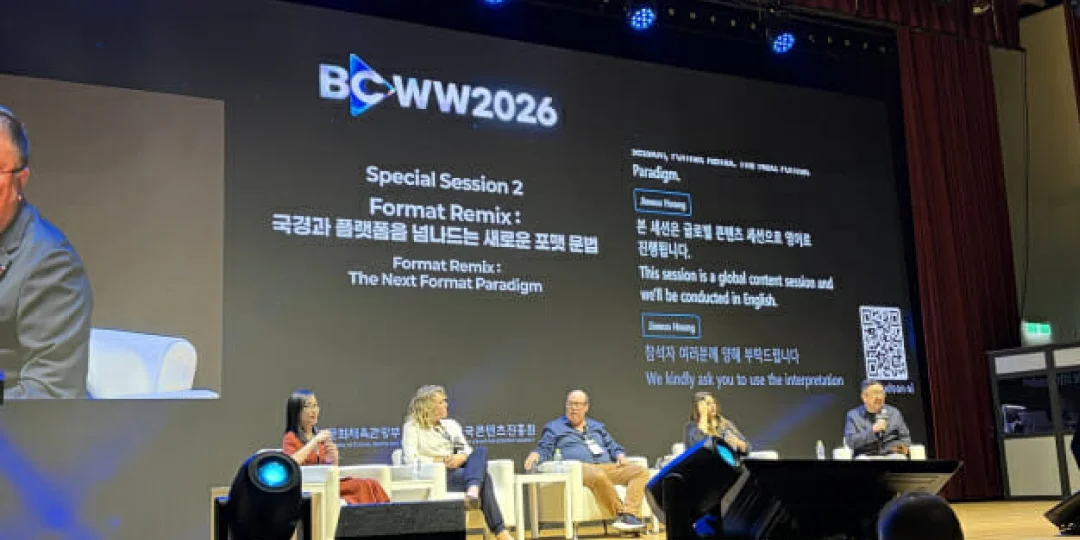
This post introduces the successful deployment and technical features of Hudson AI's real-time AI translation solution, 'Hudson Live,' which broke down global language barriers for K-content at the largest-ever '2026 BCWW'.
Based on LG U+'s KBO global dubbing case study, this article reveals a 3-STEP AI live interpretation setup designed to completely convey the commentators' explosive 'emotions' to viewers worldwide, moving beyond the simple delivery of game rules in multilingual broadcasts.

This article reveals the essential “3-Step Caption CPR” checklist—glossary preparation, direct audio input, and speaker presentation etiquette—that event managers and speakers need to prevent disastrous real-time captions at global hybrid events.
This article presents a 3-step practical guide (glossary creation, audio setup, and presentation etiquette) that organizers and speakers must follow to prevent critical interpretation errors at multilingual business events.
This article examines the structural limitations of subtitles in highly visual sports broadcasts and objectively analyzes the essential technical requirements and broadcast integration standards for adopting 'AI real-time multilingual dubbing' as a new alternative.
This article compares the real-world performance between simultaneous interpretation and AI real-time interpretation, providing clear selection criteria tailored to your company's situation.
Designed for multilingual conference planners, this guide presents seven essential technical and operational criteria to review before adopting an AI-powered real-time captioning service.
An objective look at the published specs of the three most-compared AI real-time interpretation solutions of 2026, and how the technical gap between "text subtitles" and "voice dubbing" should drive which one you pick.
The first quote from an interpretation vendor rarely shows the costs that land after the event. These ten questions — on cost, space, quality, and alternatives — put the organizer back in control of the budget.
A transparent breakdown of what interpretation actually costs at a large international event, plus practical ways to cut the budget — by optimizing existing equipment and by moving to AI real-time interpretation.
This guide walks through the limits of traditional interpretation hardware and how to run a multilingual event smoothly from attendees' own phones — no booths, no receivers.
Learn how leading studios optimize their dubbing workflow with AI-powered tools — from script adaptation to final delivery.
How Hudson AI Studio enables directors to control every emotional nuance in dubbed content — from whispered intimacy to explosive rage.
Case study: How media companies use AI-powered pipelines to deliver high-quality dubbed content in 80+ languages efficiently.
Learn how to remove vocals from any song using AI-powered audio separation. We compare 5 methods — from free online tools to professional APIs — with audio quality results.
Compare the top audio separation APIs for developers. Benchmarks on quality, latency, pricing, and features — including vocal isolation, stem splitting, and speech separation.
Detailed comparison of LALAL.AI and Hudson AI for audio separation. We compare quality, pricing, API access, stem types, and use cases to help you choose the right tool.
Learn what audio source separation is, how AI-powered stem splitting works, and its applications in music production, dubbing, broadcast, and podcast editing.
How to use AI audio separation in dubbing workflows. Step-by-step guide to extracting dialogue, preserving M&E tracks, and automating the localization pipeline.