
Tired of Endless QC Delays? Cut Your Lead Time by 90% with Agentic QC.
Stop losing hundreds of hours to 1x real-time audio QA. Discover how Hudson AI Studio’s Agentic QC and intelligent duration alignment turn weeks of grueling post-production into an autonomous workflow, cutting global delivery lead times by 90%.
Delivering practical localization insights and media tech from Hudson AI to captivate global audiences.
If you are a producer or localization manager struggling with soaring studio quotes and endless sync adjustments, here is how Hudson AI Studio’s 'Agentic QC' eliminates post-production bottlenecks.
When distributing Japanese anime or drama IPs to global markets, the single biggest drain on time and capital across the post-production pipeline is the final audio localization quality assurance (LQA) process.
For instance, in the Japanese-to-English localization of *Mobile Suit Gundam: The Origin*, dubbing a single 10-to-15-minute short episode into English consistently required 5 to 7 days of recording sessions and 12 to 14 hours of post-production. Meeting broadcast delivery standards demands a rigid linear workflow through at least five distinct stages: script adaptation, video sync alignment, pickup recordings, M&E (Music & Effects) mixing, and audio LQA. Scaled across a 12-episode series (60 minutes per episode), the raw listening time alone required just to spot audio defects runs into hundreds of hours.
The probability of passing global delivery specs on the first render approaches zero. The true success of localization hinges not on raw audio generation, but on the agility of revision and verification.
Traditional dubbing suffers from two structural bottlenecks: prolonged QC turnaround times, and the severe scheduling cascading caused whenever retakes occur due to duration mismatches or nuanced translation errors.
The true value of adopting technology in localization is not simply replacing voice talent at a lower cost. The core objective is eliminating the compounding bottlenecks of 1x real-time listening and iterative retakes through software architecture. Hudson AI Studio resolves this structural post-production inefficiency by deploying an Agentic QC workflow.
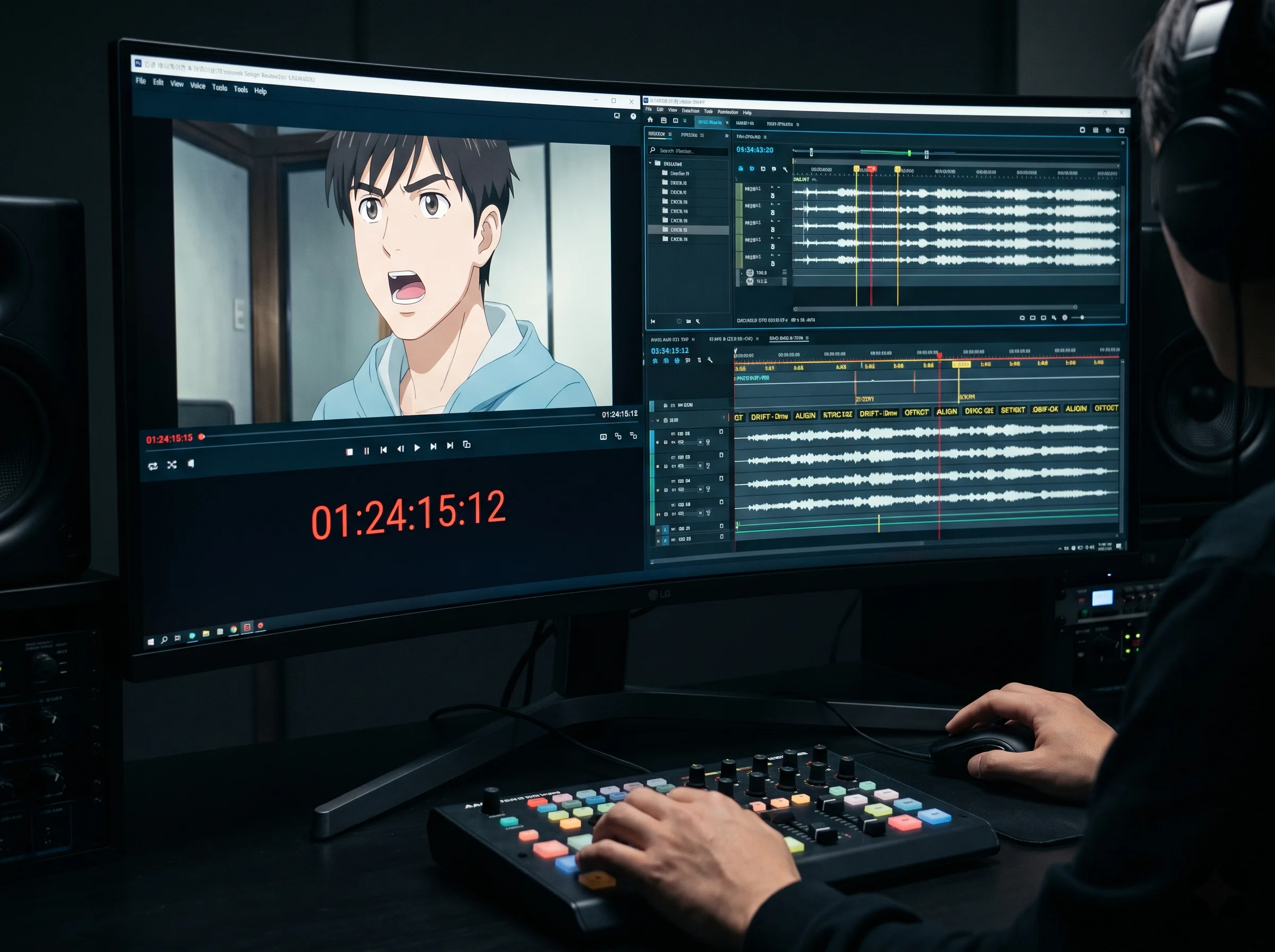
This image was created using generative AI tools.
1. The Operational Pain Point: "Linearly Compounding QC Time and the Mathematical Limits of Iterative Retakes"
When global distributors and Language Service Providers (LSPs) dub Japanese content into English, they encounter three core technical bottlenecks:
The Structural Bottleneck of 1x Real-Time Full-Listening
Audio LQA requires detecting subtle digital clipping, ambient noise, and phonetic mispronunciations, making accelerated playback impossible. Mastering a 12-episode anime series in English dubbing requires at least two to three engineers logging over 720 hours of real-time listening. As long as verification remains tethered to human real-time listening, hitting global Day-and-Date delivery schedules remains structurally out of reach.
Duration Distortion and Emotional Flattening from Syllable Expansion
Translating Japanese dialogue into English expands syllable counts by an average of 1.3x to 1.5x. Conventional voice synthesis engines lacking duration controls bleed past visual cut transitions or collide with subsequent dialogue. Furthermore, if the system fails to replicate the original voice actor’s breathing, cadence, and pitch shifts—collapsing into a flat narration style—the entire track must be scrapped and re-recorded, incurring massive cost overruns.
Fragmented Asset Formats and Non-Compliant Single-Track Audio
Real-world post-production demands continuous cross-validation among video files (MP4), time-coded subtitle files (.srt, .vtt), and multi-stem audio tracks. Yet legacy tools disconnect text subtitles from audio stems, forcing engineers to manually re-render assets after every minor copy tweak. More critically, a flattened single-track mix without separated dialogue (DX) and music & effects (M&E) stems fails broadcast and OTT delivery specifications immediately.
2. The Technological Breakthrough: "Agentic QC, A 3-Tier Autonomous Verification System Replacing Full-Listening"
One-Line Summary for Localization Managers
An end-to-end workflow where AI matches original emotional cadence and lip duration, synthesizes audio, and pre-screens for defects across three QC stages—leaving operators with only final inline approvals, without third-party studio bookings or full-length listening.
[Legacy Pipeline]
Audio Track Production ───▶ 1x Real-Time Full Listening (LQA) ───▶ Manual Defect Logging ───▶ Studio Retake Scheduling [Weeks to Months Latency]
[Agentic QC Pipeline]
Audio Generation ───▶ Agentic QC Automated Scan ───▶ Flagged Issues Review (5%) ───▶ Instant In-Editor Approval
The paradigm of dubbing localization is shifting from human operators auditing every second of audio to an intelligent hybrid pipeline where the system pre-validates integrity, leaving humans to make only executive decisions.
Triple Synchronization: Emotion, Context, and Duration
By analyzing spectrograms of the original Japanese audio, the system extracts timbre, pitch contours, and emotional intensity as multi-dimensional vectors. Understanding the contextual narrative ensures the synthesized English performance mirrors the original emotional range. Crucially, by locking the speaker’s source In and Out timecodes as absolute constraints, the engine dynamically adjusts phoneme pacing and breath intervals of the expanded English line, delivering frame-accurate A/V synchronization that aligns with lip movements and visual scene transitions.
Autonomous Multi-Tier Automated QC
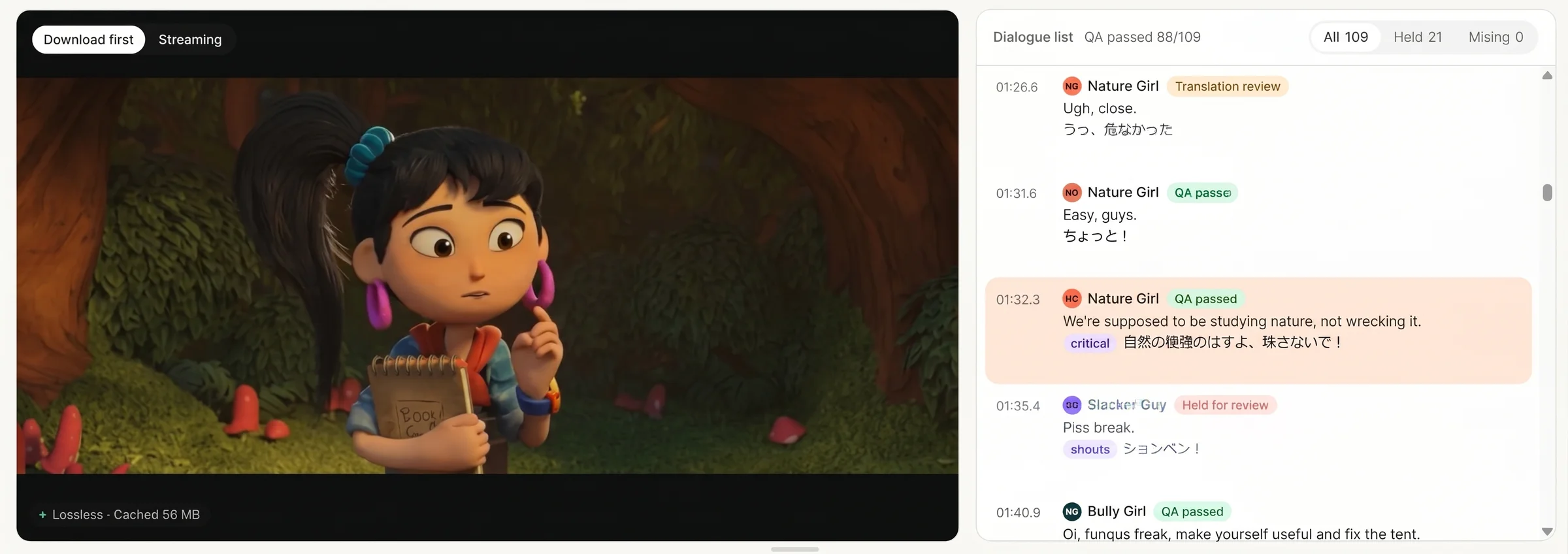
To remove real-time human listening bottlenecks, AI agents algorithmically scan the rendered audio track from start to finish. The system evaluates pronunciation clarity, silence intervals, harmonic distortion, and loudness normalization standards, tagging each dialogue line across three distinct status tiers on the timeline.
Lines marked QA Passed have already met automated compliance standards. Operators only need to review lines flagged as Translation review (optional review) or Held for review (action required), reducing total QC workloads by up to 80%.
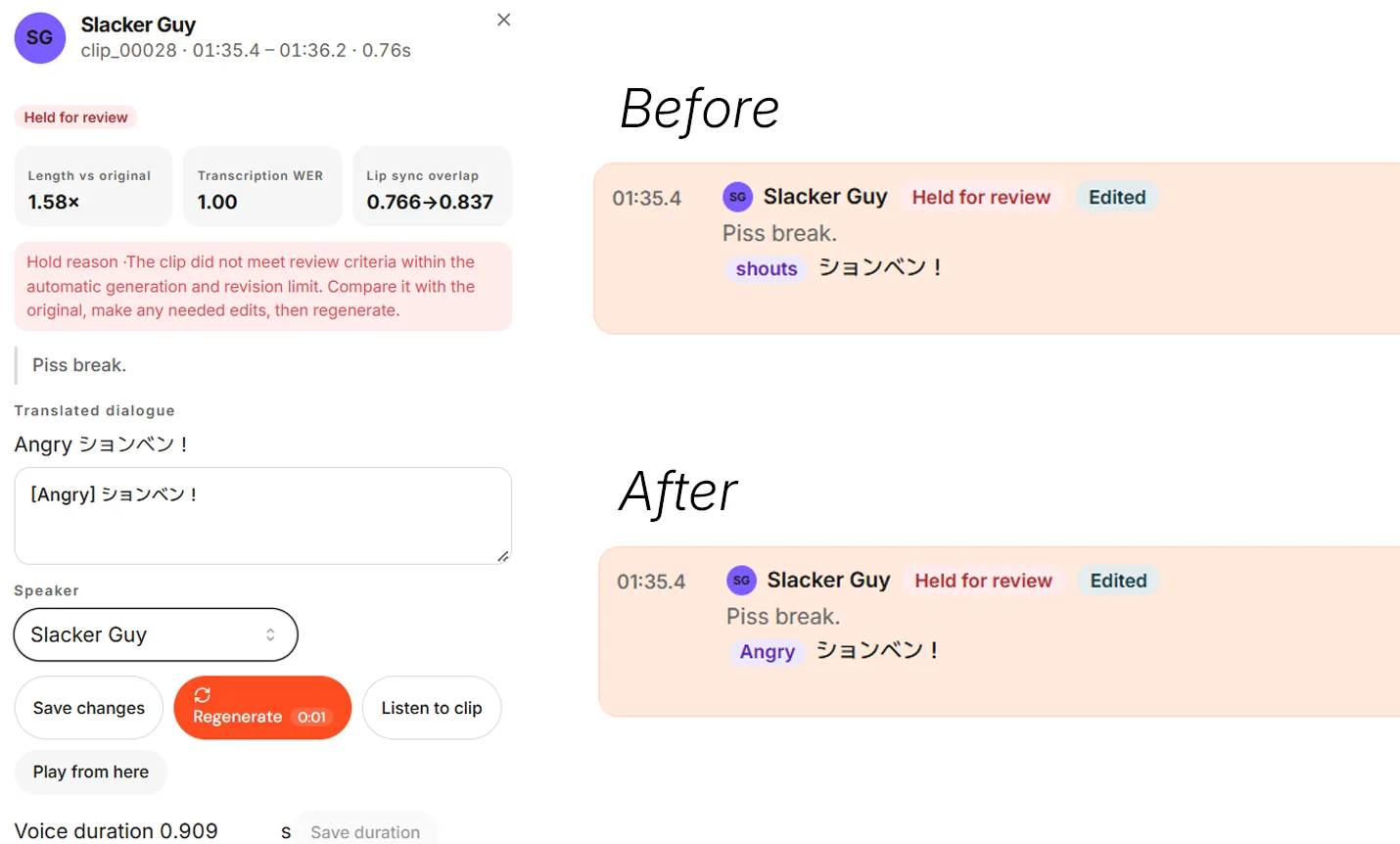
Real-Time Emotional Modulation and In-Line Duration Controls
Instead of booking studio re-records, editors can modify dialogue directly within the web workspace to regenerate localized 1- to 2-second audio segments losslessly and instantly. Emotional intensity and pitch can be adjusted via interactive sliders, without deducting additional rendering credits during the revision loop.
3. The Production Shift: "From Hundreds of Hours of Manual Listening to Pinpoint Audits of Just 5%"
Enterprise localization teams applying the Agentic QC pipeline to Japanese IP adaptations report measurable turnaround accelerations and foundational operational shifts.
Global Content Distributors: Eliminating QC Bottlenecks and Accelerating Delivery
Distributors licensing Japanese anime and drama series to Western platforms have slashed audio LQA lead times. By auditing only the flagged warning segments rather than listening through every file from start to finish, teams cut their final mastering turnaround by over 90%.
"The most grueling part of high-volume localization was manually listening through hundreds of hours of audio to check sync before delivery. Being able to pinpoint only the 5% flagged with warnings cut our turnaround by over 90%."
— Head of QC, Global Content Distributor
Tier-1 Localization Agencies (LSPs): Eliminating Retake Cost Overruns
Editorial revisions emerging during English translation supervision are resolved directly inside the editor—without scheduling talent re-recordings.
"When dubbing Japanese anime into English, syllable-expansion sync adjustments used to consume 60% of our production hours. With lines automatically aligned within In-Out timecodes and instant re-synthesis on edits, delivery delays from retakes are completely eliminated."
— Chief Technology Officer, Global LSP
Feature & Pricing Comparison Across AI Dubbing Solutions
| Evaluation Metric | Traditional Studio Dubbing | First-Gen AI Dubbing | Hudson AI Agentic QC |
|---|---|---|---|
| 12-Episode Turnaround | 3 to 4 Months | 3 to 4 Weeks (Listening bottleneck) | ~1.5 Weeks (90% Reduction) |
| Quality Control (QC) | 100% Manual Human Listening | 1x Real-Time Manual Listening | Automated Pre-Scan + 5% Flagged Review |
| Duration Control (A/V Sync) | Manual voice actor adaptation | Syllable overflow past cuts | Automated In-Out Timecode Conformance |
| Dialogue Revision (Retake) Cost | Voice talent re-booking + studio fees | Per-character regeneration fees | $0 Extra Cost (Instant inline re-synthesis) |
| Broadcast Delivery Compliance | Dedicated mixing engineer required | Flattened single track (Non-compliant) | Multi-Stem Export (DX / M&E separated) |
Closing Thoughts: For Flawless Dubbing, Your Only Role Is the Final Decision
Leave the mechanical engineering—calculating syllable counts, aligning dialogue duration, and hunting down acoustic anomalies—to autonomous AI agents. The system synthesizes the optimal voice, applies rigorous three-tier quality screening, and flags only the exceptions that matter.
Free your pipeline from post-production bottlenecks so you can focus entirely on executive creative direction and final sign-off.
Are delivery delays during content QC holding back your release schedule?
Experience dramatic lead-time compression firsthand with Hudson AI Studio’s Agentic QC and automated duration synchronization.
Bring AI dubbing to your content
Dub your content into 80+ languages with director-level control. Talk to our team about rolling it out.